The Donald Crowhurst Mystery
The Donald Crowhurst mystery begins with a race that nobody had ever tried before and ends with an empty boat in the middle of the Atlantic.
The 1968 Golden Globe Race
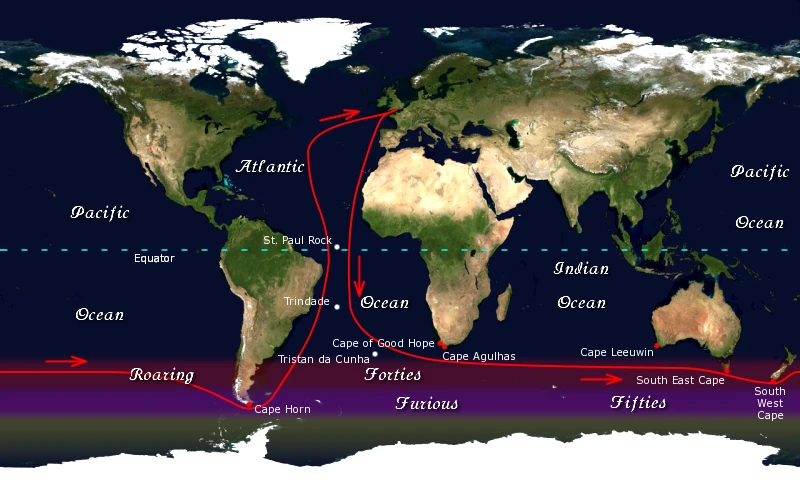
In 1968 the Sunday Times offered a trophy, the Golden Globe, to the first sailor to go around the world alone without stopping. It also offered £5,000 for the fastest time. Entrants could start at any point between 1 June and 31 October 1968. Nine men set off. Only Robin Knox-Johnston finished.

Donald Crowhurst
Crowhurst was a 36-year-old amateur sailor from Bridgwater in Somerset. He ran a small electronics business that was struggling. He hoped the prize money and publicity from the race would help the business, and he put his home and his business on the line to take part.
Leaving Teignmouth
He left Teignmouth on 31 October 1968, the last day allowed. The boat was not fully ready. Some of the equipment he had planned was unfinished, and he had little time to test her. Early on he ran into trouble with the boat and fell behind.
The false positions
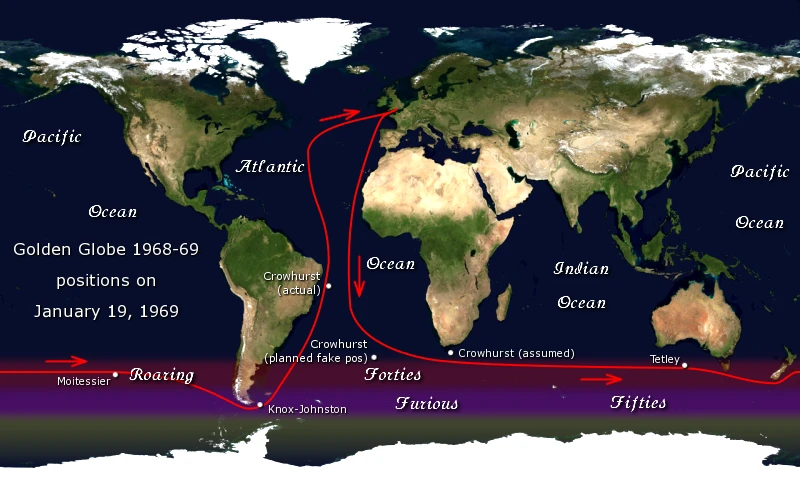
Crowhurst did not follow the route he described. He stayed in the Atlantic while sending radio messages that placed him further along. He kept two logbooks, one with his real position and one with an invented voyage. In one report he claimed to have sailed 243 nautical miles in a single day, which would have been a record.

The silence
As the race went on, other sailors dropped out. Nigel Tetley pushed his boat hard to stay ahead of Crowhurst, and his trimaran Victress sank on 21 May 1969. Tetley was rescued. That left Crowhurst looking like a possible winner of the fastest-time prize, which would have meant his logs being checked closely.
His radio messages stopped. His last log entries are dated 1 July 1969.
The empty boat
On 10 July 1969 a Royal Mail ship, the Picardy, found the Teignmouth Electron drifting in the Atlantic. Crowhurst was not on board, but his logbooks were. It is generally believed he went overboard and was lost at sea. His body was never found. He left behind his wife, Clare, and their four children.
What came after
Knox-Johnston won both the Golden Globe and the £5,000 prize, and gave the money to Crowhurst’s family. Tetley received a consolation prize of £1,000. The story has since been told in books, a documentary and two feature films, Crowhurst and The Mercy.
Read what happened to the boat next on the Teignmouth Electron on Cayman Brac.
Sources
- Nicholas Tomalin and Ron Hall, The Strange Last Voyage of Donald Crowhurst (1970).
- Peter Nichols, A Voyage for Madmen (2001).
- Deep Water (2006), documentary directed by Louise Osmond and Jerry Rothwell.
- Wikipedia, “Golden Globe Race (1968)” and “Donald Crowhurst”.